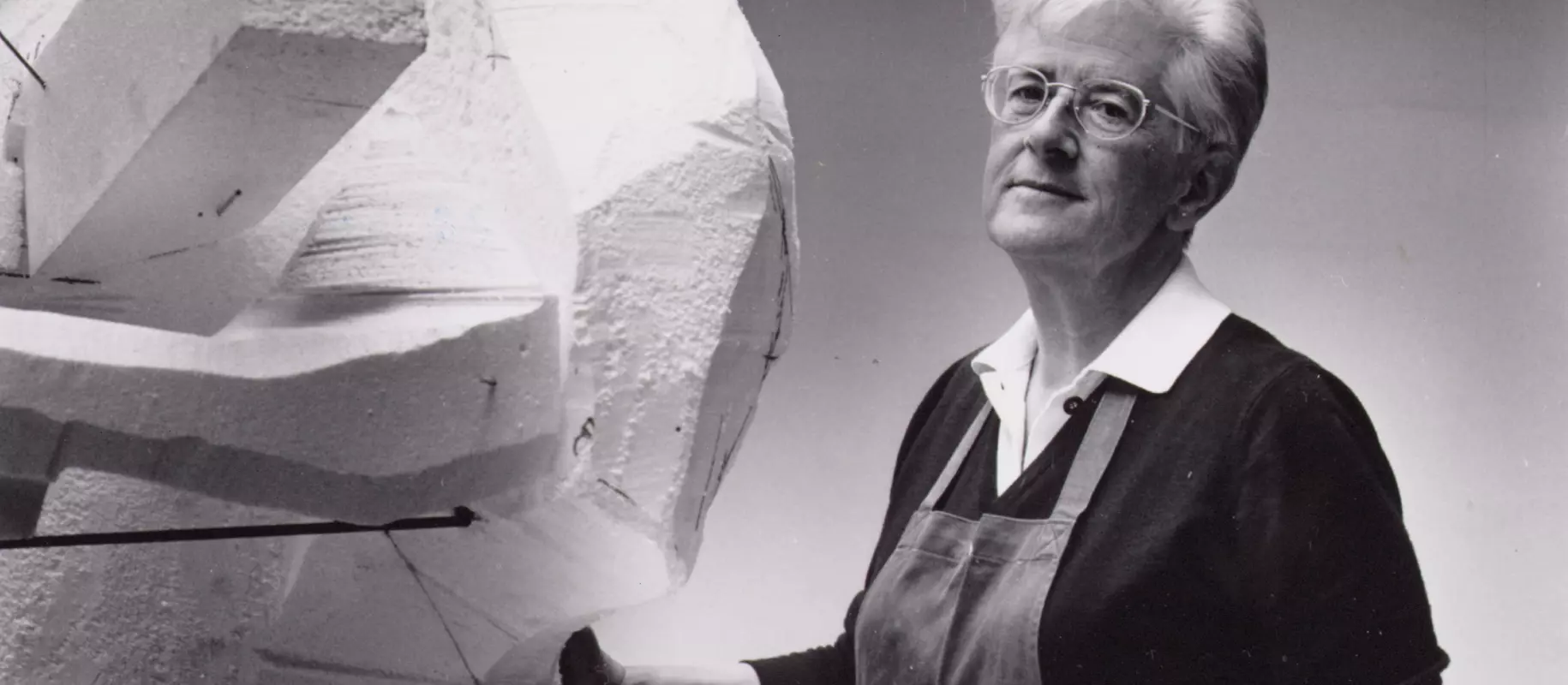
Theresia van der Pant (1924-2013)
Theresia van der Pant is one of the most important Dutch post-war sculptors of the 20th century. She primarily created abstracted animal sculptures in a figurative style, beautifully rendered in bronze or stone. Animals were her favourite subject, and she studied them extensively at Artis Zoo to capture their essence. She did not depict them as individuals, but created sculptures in which characteristic shapes and postures determine the composition. ‘Animals do not feign or pose, and that gave them a certain freedom,’ Van der Pant noted. Giraffes, seals, fish, bison and especially birds form part of her oeuvre, and many of these sculptures remain on display in public spaces today.
Portraits of people were rare within her body of work. She modelled, for example, the heads of composers such as Monteverdi and Stravinsky — figures for whom she felt a strong affinity. Her best-known sculpture is the equestrian statue of Queen Wilhelmina on the Rokin in Amsterdam, in which she beautifully combined human and animal forms.
Education and development
Theresia van der Pant completed a two-year preparatory course at the Rijksnormaalschool voor Teekenleraren (National Normal School for Art Teachers), which granted her swift admission to the Rijksakademie van Beeldende Kunsten (National Academy of Fine Arts) in Amsterdam in the mid-1940s. In 1950, she spent some time working in the studio of the Belgian sculptor Oscar Jespers in Brussels. Among other things, he taught her to develop her visual memory, a skill that would later prove invaluable to her. From then on, she modelled and drew exclusively from memory, following extensive observation.
Her breakthrough came in 1953, when she won second prize in the prestigious Prix de Rome for Sculpture. She moved into a small studio on the island of Wittenburg in Amsterdam and became a member of the artists’ association Arti et Amicitiae. She soon began receiving commissions from various municipalities for animal sculptures to be placed in public spaces.
Teaching and career awards
From 1965 onwards, Van der Pant taught stone carving at the Rijksakademie, where she was appointed professor of sculpture in 1979. She left the academy in 1982. That same year, she married the artist Nol Kneulman and exchanged her studio on Wittenburg for a house on Plantage Muidergracht, where she had a more spacious workshop and a separate drawing studio.
In 1987, Van der Pant received the Judith Leyster Prize, an award recognising the work of female artists. Two years later, she was honoured with a retrospective exhibition at the Frans Hals Museum in Haarlem. To mark her 65th birthday, the exhibition was subsequently shown in her hometown of Schiedam.
At the age of 82, Theresia van der Pant was forced to end her sculpting practice due to health reasons. She remained active as a draughtswoman well into old age, often working in pastel and ink.
Exhibition and publication
From 16 January to 3 May 2026, Museum Beelden aan Zee will present a special selection of her work in the Cabinet and the Sea Room. The exhibition is curated by Joost Bergman and Camée van Blommestein.
At the same time, Theresia van der Pant will be published as volume 13 in the Monographs series of Museum Beelden aan Zee (final editing by Dick van Broekhuizen, with contributions from Claartje de Loor). In addition to articles on her life, sculptures and drawings, the publication also includes a catalogue of her complete oeuvre.