From
31 October 2026
Jakob Grosse-Ophoff
Through
11 April 2027
From
31 October 2026
Through
11 April 2027
31 October 2026 - 11 April 2027
Jakob Grosse-Ophoff
Myself and Other Planets
Jakob Grosse-Ophoff (Oldenburg, 1991) portrays human emotions in a playful and relatable manner. After training as a mechanical engineer, he taught himself to become a sculptor. Through his kinetic sculptures, he captures comic, poetic, and everyday moments that evoke universal emotions. Discover his first solo museum exhibition in the Zuidzaal of the Beelden aan Zee museum from 31 October 2026 through 11 April 2027.
Curator: Iris van der Zee
In an age of rapid technological change and an increasing fixation on virtual ‘perfection’, Grosse-Ophoff returns to simplicity. Using wood and metal, sometimes combined with everyday objects, he creates sculptures that mimic human gestures. These movements are mechanically driven by ordinary domestic motors or hand cranks. Rather than striving for anatomical realism, his focus lies in the recognisability of expression.
Grosse-Ophoff often reduces the human figure to a single gesture or even just a mouth. At times, the human body disappears altogether, yet its presence remains unmistakable. Visitors activate the works by pressing a button, turning a crank, or moving past a sensor. Hugger (2025) even engages the entire body: by leaning one’s chest against a wooden spring, two wooden arms gently embrace the participant.
His work resonates with the tradition of German wood sculptors such as Stephan Balkenhol and Georg Baselitz, while also drawing inspiration from kinetic artists including Jean Tinguely and Theo Jansen. The active role assigned to the viewer likewise recalls performance art. In some cases, the lifespan of a work is as fleeting as its documentation.
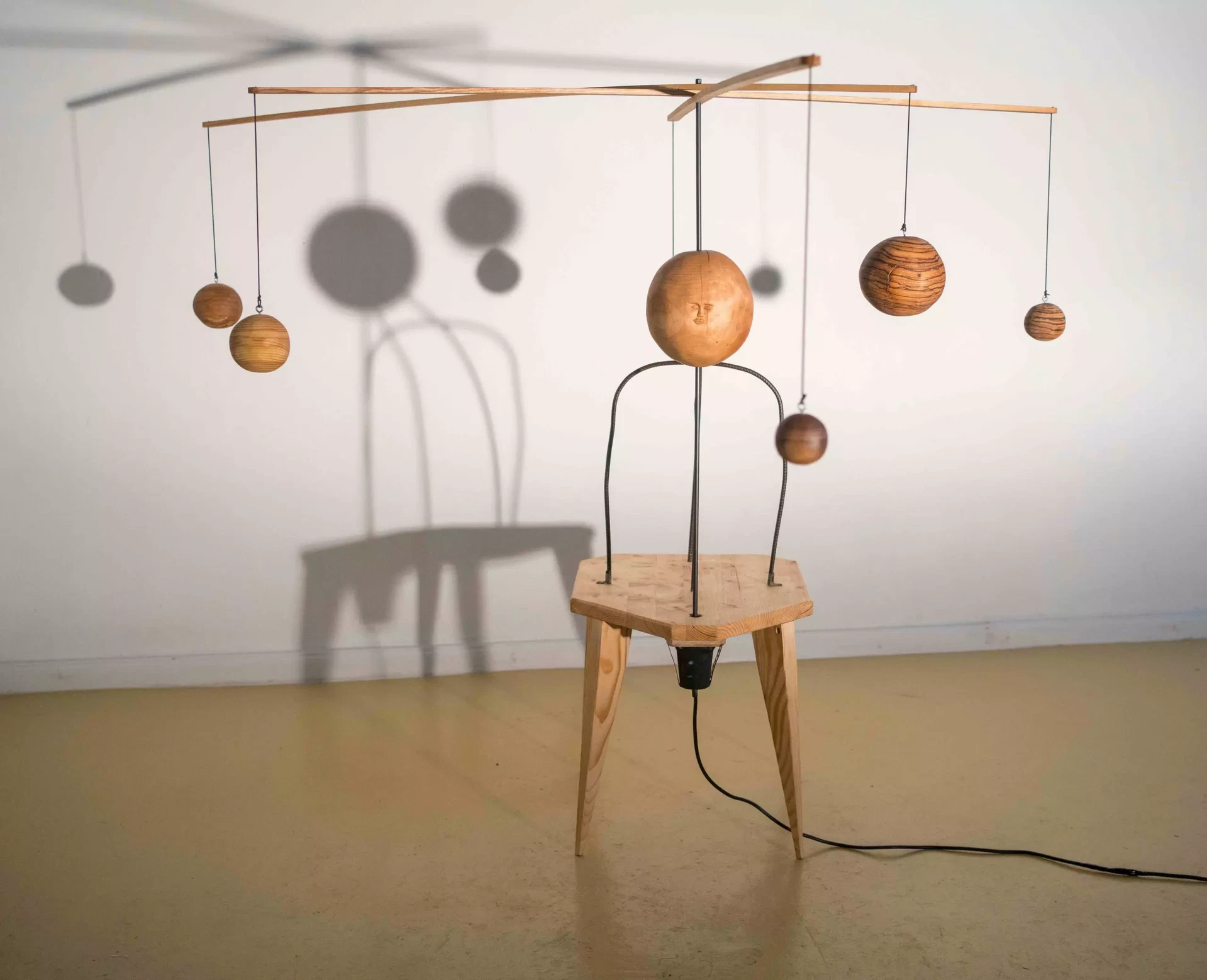
The exhibition title, Myself and Other Planets, refers to a work from 2023: a kinetic solar system in which an anthropomorphised sun occupies the human-centred position at the heart of the universe. Playfully alluding to today’s narcissistic selfie culture, the title also captures the essence of Grosse-Ophoff’s practice, exploring how people relate both to themselves and to others.
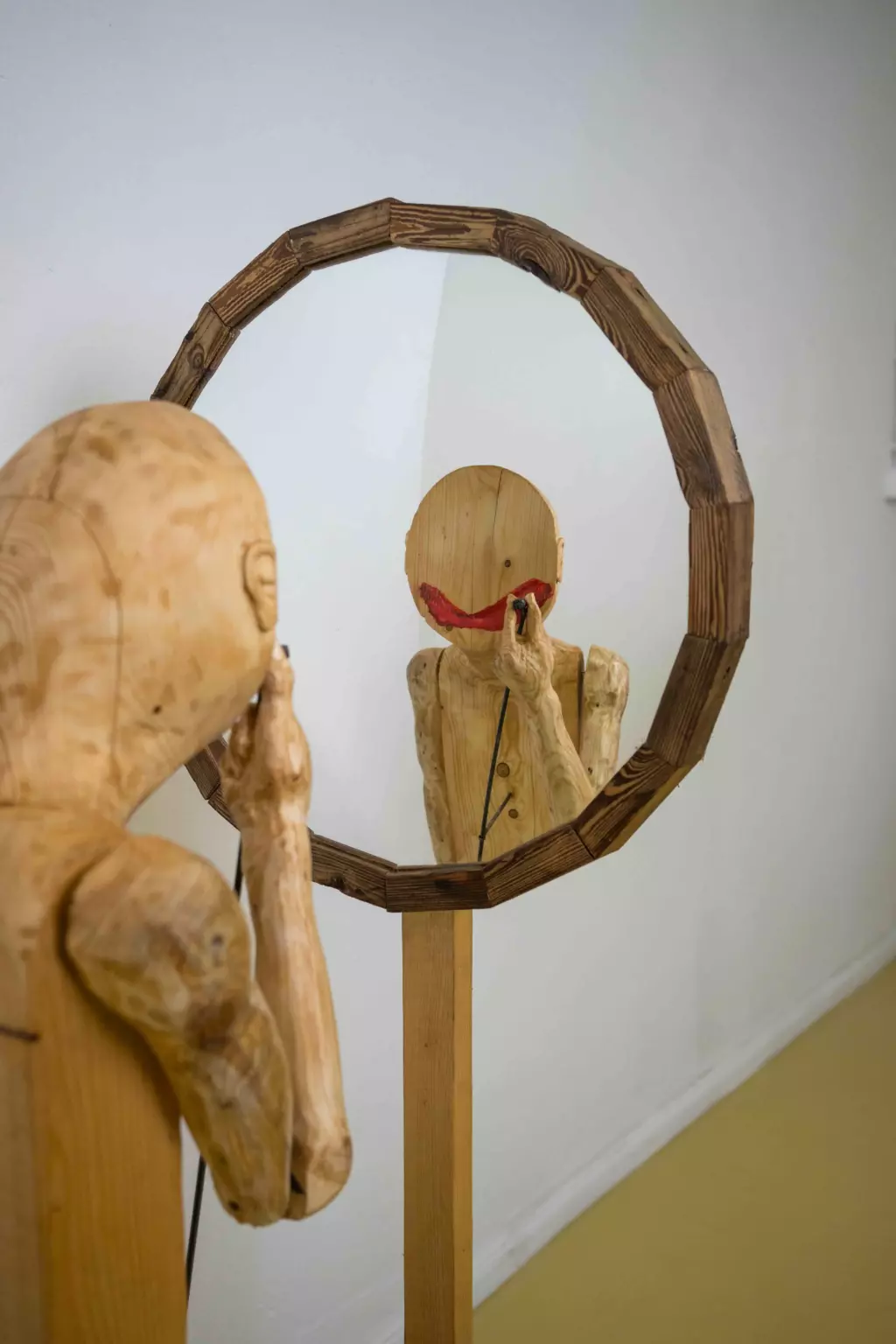
Human interaction lies at the heart of the exhibition. Figures converse, kiss, or fight. Other works explore self-perception, whether through a mirror or by staging the cinematic trope of a slap in one’s own face. Finally, the sculptures establish a direct relationship with the audience, offering a blown kiss, a meaningful hand gesture, or even a physical embrace.
Thumbnail / mobile image: Jakob Grosse-Ophoff, Painted Happy
Header image: Jakob Grosse-Ophoff, Myself and Other Planets
Partner