Rui Chafes
Rui Chafes studied sculpture in Lisbon and continued his education at the Kunstakademie in Düsseldorf under Gerhard Merz. During this period, he translated Novalis’ Fragments into Portuguese and published the text in a book with drawings. Chafes was deeply influenced by the Romantic poet and his ideas about melancholy, onging for death, and the night, as keys to understanding reality and the ‘true’ human soul. Novalis's assertion that "all forces of nature are essentially but one single, all-encompassing force" is the guiding principle in the creation of Chafes' abstract and sometimes semi-figurative sculptures.
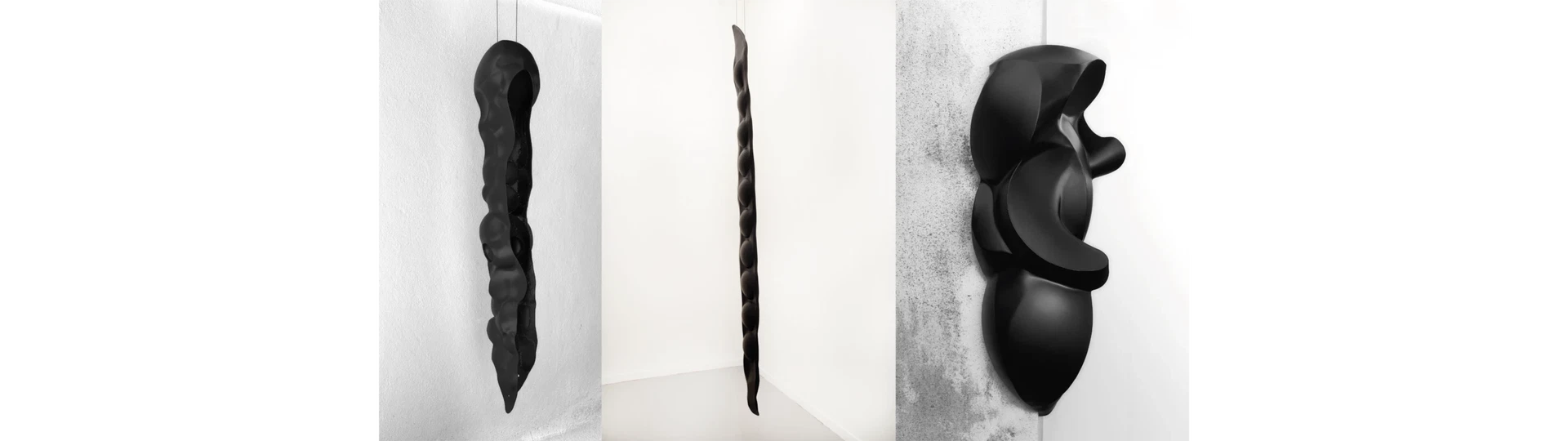
Chafes belongs to a generation of artists who are redefining the sculptural as a spiritual experience. Since the nineteen nineties, he has been building a consistent oeuvre of iron sculptures, often matte black and closed in form, yet imbued with an intense charge. His works almost seem to float, breathe, or sometimes shelter. In the spirit of late Romanticism, they refer not only to the emptiness of human existence but also to the ambivalence of the body, which is both a ‘cage’ in which the ‘self’ is imprisoned and a protective shell that shields the inner self from a physically and mentally threatening environment. His sculptures are not cast but folded from sheet steel, thus emerging ‘from nothing’. Despite their heavy weight, their pure form and apparent absence of materiality they almost appear to be floating. Hence they are always situated in a zone between perception and reality, between life and death, between mind and body. This disquieting effect combined with the romantic and existential themes atypical in this day and age, which evoke ‘forgotten’ feelings of loneliness, detachment,